
Too Much Fiber? The Symptoms, the False Alarms, and What Actually Fixes It
You did the thing everyone recommends. You doubled the vegetables, switched to whole grains, started on the chia — and within a couple of days you are bloated, gassy, cramping, and either going constantly or not going at all. So the obvious question: did I overdo it? Usually the answer is not too much fiber, but too much too fast — and almost every official body that writes about this says the same thing. Here is what the symptoms actually look like, how to tell them apart from something that needs a doctor, and the specific ramp that fixes it.
The short version
- The classic signs are gas, bloating and abdominal cramps, and sometimes constipation or loose stools — NIH’s MedlinePlus ties them specifically to “a large amount of fiber in a short period of time”
- None of the major bodies publish a hard “too much” number; they publish targets — 22–34g a day for adults (NIDDK), up to 38g for younger men (Cleveland Clinic)
- The fix is pace and water: add no more than 5g a week (Cleveland Clinic) and drink about 8 glasses of fluid a day (MedlinePlus)
- Constipation after adding fiber usually means fiber without enough water
- Very high intakes can interfere with absorbing iron, zinc, magnesium and calcium — a real effect, mostly relevant at supplement-heavy extremes
- Bleeding, severe or constant pain, vomiting, fever or weight loss are not fiber symptoms — those need a doctor, not a smaller bowl of oats
The answer in sixty seconds
If you recently increased your fiber and you now have gas, bloating and cramps but no alarming symptoms, the most likely explanation is that your gut has not caught up yet. The bacteria in your large intestine are doing exactly what they are supposed to do with the extra fiber — fermenting it — and the by-product is gas. That settles as they adapt. The official advice, from NIDDK to the Cleveland Clinic, is not to stop: it is to slow down, hold at a level that is comfortable, drink more, and climb again.
If you have been at a high intake for a long time and feel fine, you are not “eating too much fiber” by any definition these bodies use; they set minimums, not ceilings. And if the symptoms include blood, fever, vomiting, severe pain or unexplained weight loss, stop reading about fiber and book an appointment — those are not things fiber does.
What “too much fiber” actually feels like
MedlinePlus, the US National Library of Medicine’s patient resource, puts it plainly: “Eating a large amount of fiber in a short period of time can cause intestinal gas (flatulence), bloating, and abdominal cramps.” The Cleveland Clinic says the same from the other direction — “Adding too much fiber all at once can cause bloating and cramping” — and adds the one people do not expect: increasing fiber without increasing water “can lead to constipation.”
So the list is short, and it is worth noticing what is not on it:
| What you notice | What it usually means | What to do |
|---|---|---|
| More gas than usual, a few days after adding fiber | Normal fermentation; gut bacteria adjusting | Hold your intake steady for a week, then climb again |
| Bloating, a tight or full feeling after meals | Same mechanism; often worse with beans, bran, onions | Smaller portions of the new food, spread across the day |
| Cramping or mild stomach ache | Bulk and gas moving through; usually eases within days | Slow the ramp; add fluid; avoid adding a supplement on top |
| Constipation after adding fiber | Fiber without enough water (Cleveland Clinic) | Increase fluids first; if no change in a week, reduce the fiber slightly |
| Looser, more frequent stools | Common with a sudden jump in fruit, soluble fiber or supplements | Back off the newest addition; reintroduce gradually |
| Blood, black stools, fever, vomiting, severe or constant pain, weight loss | Not a fiber symptom | See a doctor |

The false alarms: what is not a sign of too much
This is the part nobody writes down, so people end up on forums arguing about it.
More gas is not a warning sign. It is the expected result of feeding fiber to gut bacteria, and the pattern most people report is that it peaks in the first week or two of a change and settles. None of the sources here treat ordinary gas as a reason to reduce fiber — only as a reason to add it more slowly.
Going more often is not “too much” either, if the stools are normal. Fiber adds bulk; more bulk, more movement. That is the advertised effect.
Feeling full sooner is fiber doing what it does, not a problem — unless you are unintentionally losing weight or struggling to eat enough, which is a different conversation and a doctor’s one.
A high number on its own is not a symptom. Populations eating traditional high-fiber diets routinely exceed 50g a day without the side-effects people worry about, because they have always eaten that way. The issue in almost every case here is the speed of the change, not the destination.
Is there an official upper limit?
Not in the sources we checked. NIDDK says “adults should get 22 to 34 grams of fiber a day.” MedlinePlus gives 21 to 38 grams for older children, adolescents and adults. The Cleveland Clinic breaks it down further — 28g for women and 34g for men aged 19–30, 25g and 31g at 31–50, 22g and 28g at 51 and older. The NHS uses a flat 30g for adults. Harvard’s Nutrition Source says 25 to 35 grams, and notes that “most Americans get only about 15 grams a day.” The NHS makes the same point for the UK: most adults average around 20g.
Every one of those is a floor. There is no number in any of them at which fiber becomes harmful for a healthy adult. What they warn about is the rate of increase and the water, which is why the rest of this article is about those two things.

The one genuine caution: minerals
MedlinePlus notes that “too much fiber may interfere with the absorption of minerals such as iron, zinc, magnesium, and calcium.” This is the real, documented downside of very high intakes — and it is worth keeping in proportion. It is mainly a concern at extremes, especially when a lot of the fiber comes from bran or supplements taken alongside meals, rather than from eating more beans and vegetables. If you are already low in iron or have been told to watch your calcium, it is a reasonable thing to mention to whoever looks after that.
How fast to increase — the actual numbers
The Cleveland Clinic is the most specific: “add in no more than 5 grams of fiber per week until you reach your individual goal.” MedlinePlus says to “add fiber gradually over a period of a few weeks to avoid stomach distress,” and that adding it “slowly, instead of all at one time, can help reduce gas or diarrhea.” NIDDK: “add fiber to your diet a little at a time so your body gets used to the change.”
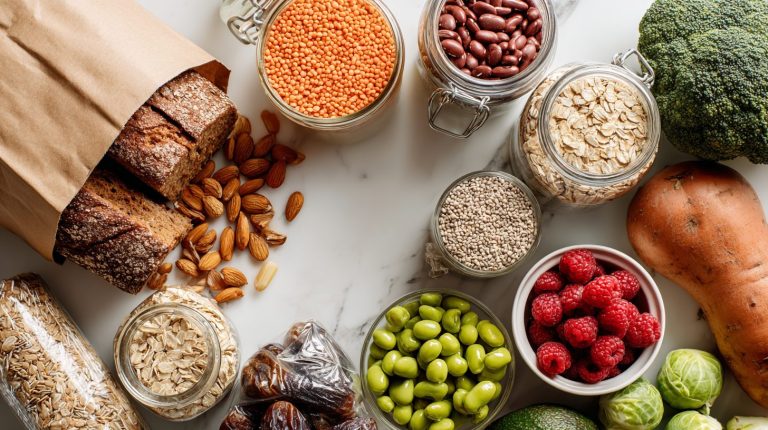
Five grams is small. It is one slice of seeded bread swapped for white, or half a cup of beans added to something you already eat, or a tablespoon of chia in the morning. If you went from 15g to 35g over a weekend, that is four weeks of increase done in two days, and the symptoms make sense. The fix is not to retreat to 15g — it is to hold at wherever you are comfortable and climb at the slower rate.
Water, specifically
MedlinePlus: “Water helps fiber pass through the digestive system. Drink plenty of fluids (about 8 glasses of water or noncaloric fluid a day).” The Cleveland Clinic calls water “essential to keep your bowel movements regular” when adding fiber. NIDDK recommends water and other liquids “to help the fiber work better.”
The mechanism is simple. Fiber absorbs water; if you add fiber and not water, it absorbs it from the stool instead, which is how a bowl of bran ends up making you more constipated. Anyone whose main symptom is constipation after adding fiber should fix the water before touching anything else.

Supplements versus food
A psyllium or methylcellulose supplement can add 5–10 grams in one dose, which is exactly the kind of sudden jump the advice above tells you to avoid — and a supplement on top of a diet you have already increased is the most common way people end up here. Harvard also notes that “people with irritable bowel syndrome may be sensitive to these fibers that can cause bloating or stomach upset,” which matters if you suspect IBS. The Cleveland Clinic recommends talking to a healthcare professional “before taking any supplement, fiber included.” Food ramps slower by nature, which is most of why it is the better route.
When it is not fiber
Fiber causes gas, bloating, cramps, and bowel habits that shift for a while. It does not cause bleeding, black or tarry stools, fever, vomiting, severe or constant pain, or unexplained weight loss. If any of those are present, the fiber is a coincidence and the right move is an appointment. The same goes for symptoms that do not settle after a few weeks at a steady, moderate intake with enough water — at that point “it’s the fiber” has stopped being the likely explanation, and our fiber for constipation guide covers where the line is in more detail.
Frequently asked questions
How long do too-much-fiber symptoms last?
None of the sources put a number on it, and we will not invent one. The consistent pattern — and the logic behind the “increase gradually over a few weeks” advice — is that gas and bloating from a change ease over days to a couple of weeks as the gut adapts. If they are not easing at a steady intake with adequate water, reduce the newest addition and, if that does not help, ask a doctor.
Can too much fiber cause constipation?
Fiber without enough water can; the Cleveland Clinic says so directly. Increase fluids first.
Is 50 grams a day too much?
No body we checked says so. It is well above the targets, but the targets are minimums, and the warnings are about the rate of change and water rather than a ceiling. If you arrived at 50g gradually, feel fine, and are not relying on supplements for it, there is nothing in the guidance telling you to come down.
Should I stop eating fiber until the bloating passes?
The guidance points the other way: hold steady rather than stop, and let your gut catch up. Stopping and restarting just repeats the adjustment.
The bottom line
Gas, bloating and cramps after adding fiber are almost always a pace problem, not a quantity problem. The fix has two parts, both from the official guidance: no more than about 5 grams more per week, and around 8 glasses of fluid a day while you do it. Nothing in the published advice sets an upper limit for healthy adults; the one documented caution at extremes is mineral absorption. And the symptoms that actually matter — blood, fever, vomiting, severe pain, weight loss — are not fiber symptoms at all.
If you want to climb without the uncomfortable week, fibermaxxing 101 is the slow-ramp version of this site, what 30 grams of fiber a day actually looks like shows how ordinary the food is at the target, and soluble vs insoluble fiber explains why beans and bran feel different on the way through. Fiber questions answered picks up the rest.
Get the free Fibermaxxing Starter Kit
A 7-day plan, 5 tested recipes & a fridge cheat sheet — straight to your inbox.
No spam, just recipes. Unsubscribe anytime.

Emma Hartwell
Emma Hartwell is the home cook and recipe developer behind Fiber & Fork. After years of dealing with sluggish digestion and endless afternoon energy crashes, she rebuilt her kitchen around one simple idea: hit 30 grams of fiber a day without eating a single boring meal. Every recipe on this site is cooked, photographed, and taste-tested in her own kitchen — beans, lentils, whole grains, and vegetables turned into food you'll actually crave. When she's not stirring a pot of something cozy, Emma is testing new ways to sneak fiber into desserts her family can't tell apart from the 'real thing'.