Soluble vs Insoluble Fiber: The Chart, and What It Actually Changes
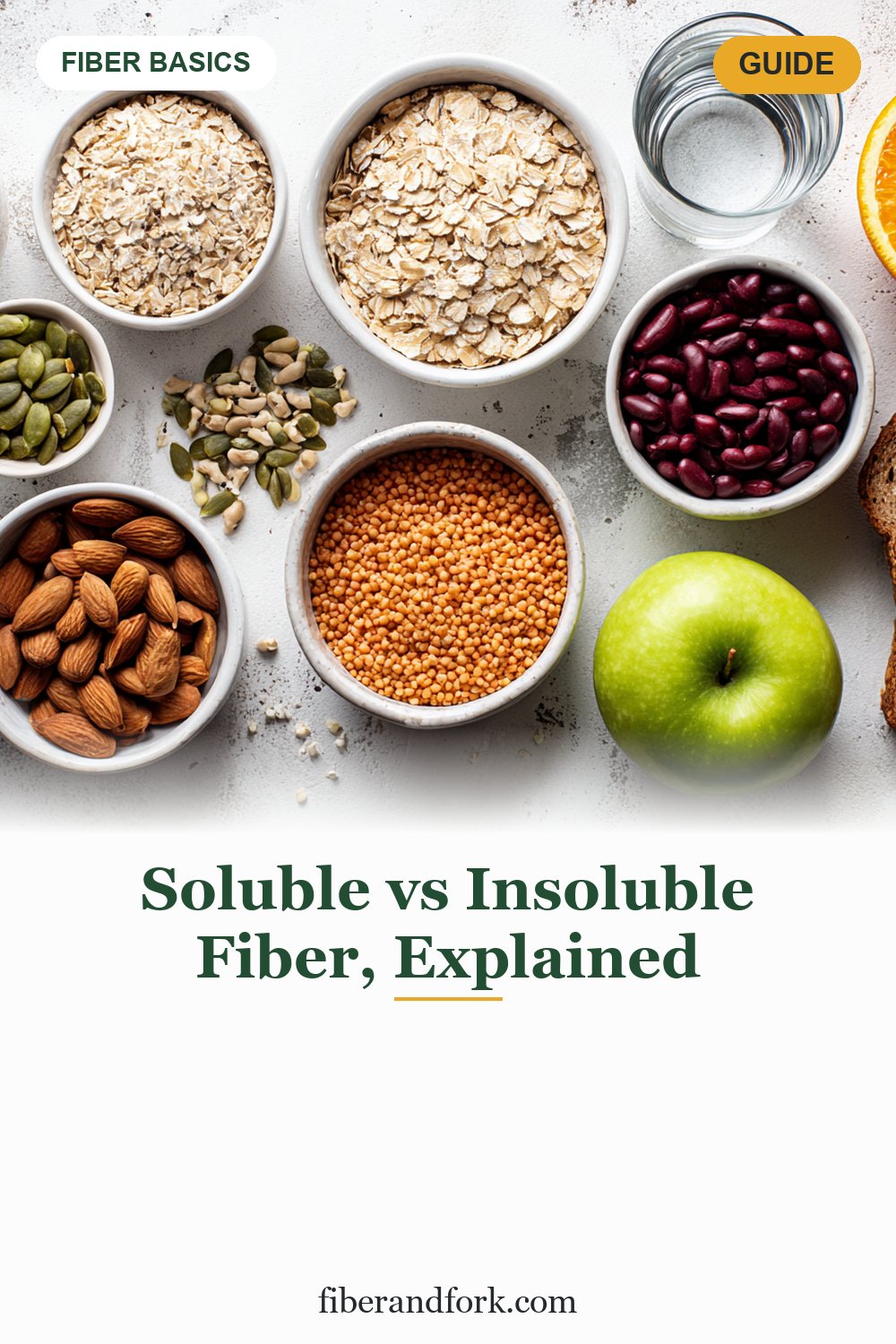
You have almost certainly seen the chart. Soluble on the left, insoluble on the right, oats in one column and wheat bran in the other. What almost none of them tell you is the part that actually changes your shopping: nearly every plant food contains both, there is no separate daily target for either one, and your food label is not going to tell you the split. Here is the chart anyway — and then what genuinely follows from it.
The short version
- Soluble dissolves and forms a gel — it slows digestion and binds cholesterol
- Insoluble does not dissolve — it adds bulk and moves things along
- There is no separate daily recommendation for each; the targets are for total fiber
- Almost every whole plant food has both, so variety beats optimising
- The one place the split really matters: constipation, IBS and cholesterol
The actual difference, in one glass of water
The names are literal, which is unusual for nutrition. Soluble fiber dissolves in water; insoluble fiber does not.
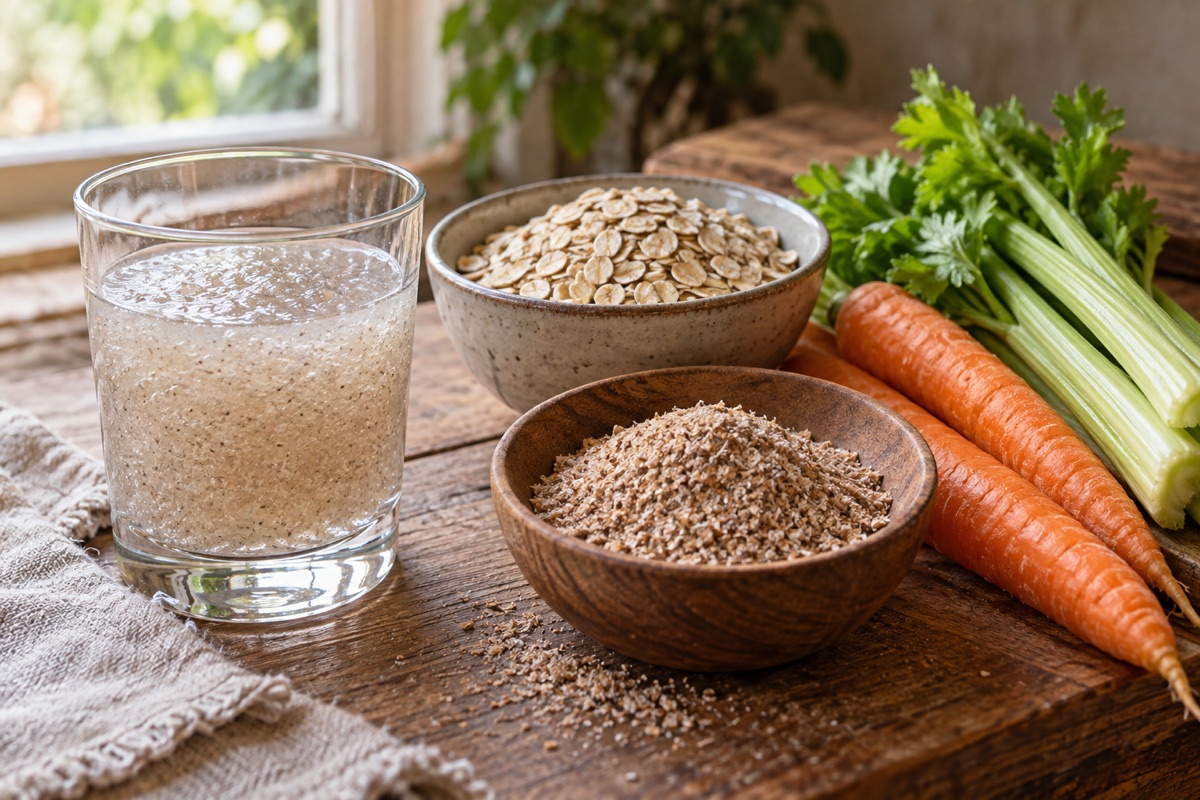
Stir oats into a glass and leave them, and the water turns thick and slightly slimy — that is soluble fiber going into solution. The National Library of Medicine’s description is that soluble fiber “attracts water and turns to gel during digestion”, which “slows digestion”. Do the same with wheat bran and the water stays clear while the bran sits on the bottom. It is still there; it simply never joins in.
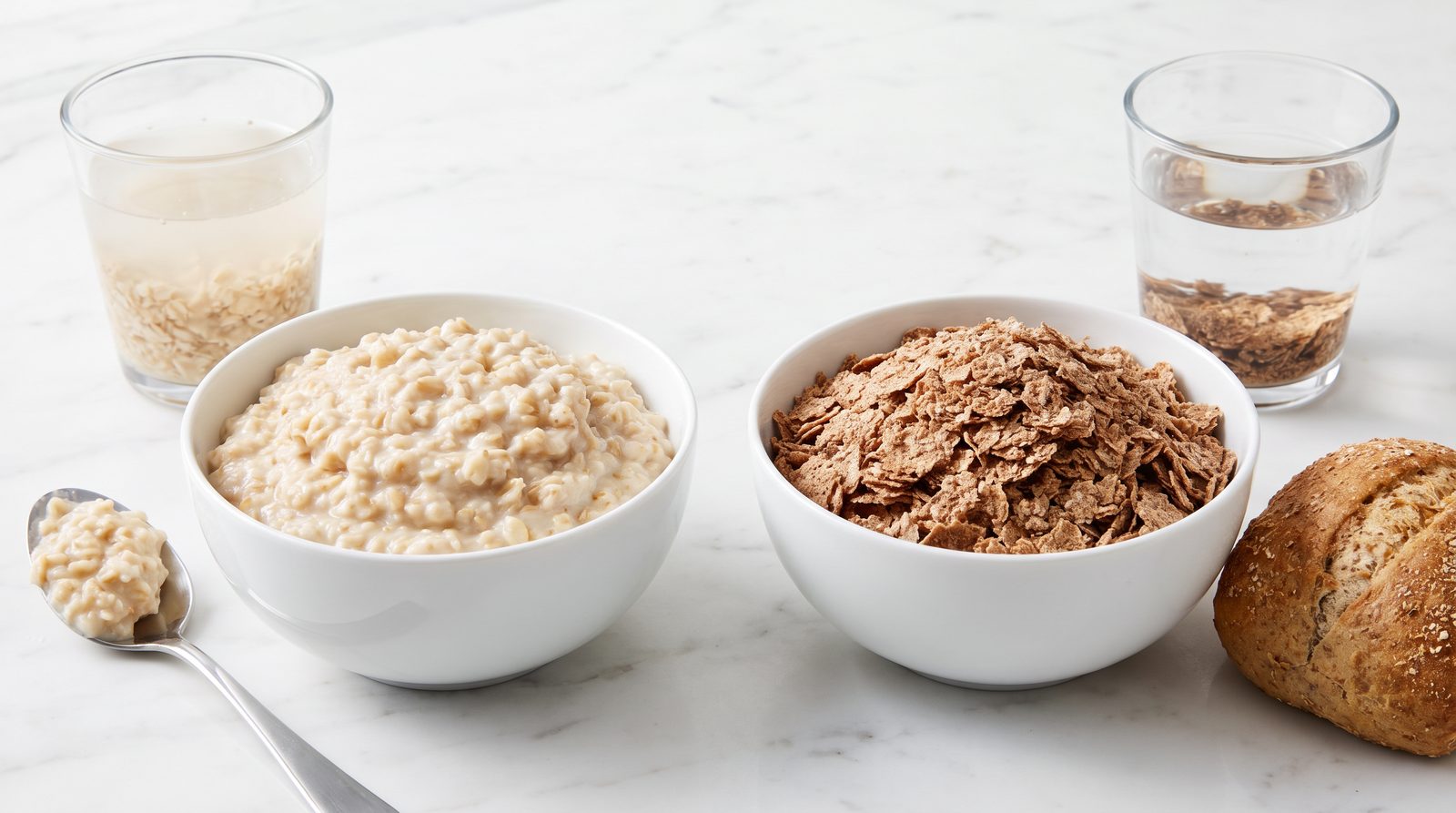
That difference in behaviour is the reason they do different jobs in you. A gel slows things down — it is physically harder for digestive enzymes to work through, so sugars are released more gradually. Cleveland Clinic describes soluble fiber binding “with cholesterol and bile acids in the digestive tract, preventing it from being absorbed into the bloodstream”, which is the mechanism behind the cholesterol claims.
Insoluble fiber does the opposite: it stays intact, holds water in the stool, and — as the National Library of Medicine puts it — “adds bulk to the stool and appears to help food pass more quickly through the stomach and intestines”.
The chart
Food sources below are as listed by the National Library of Medicine and Cleveland Clinic. The fiber figures are total dietary fiber per typical portion, calculated from USDA’s published table — because that is what exists. Read on for why there is no column here splitting the grams.
| Type | Where it is | What it does | Best for |
|---|---|---|---|
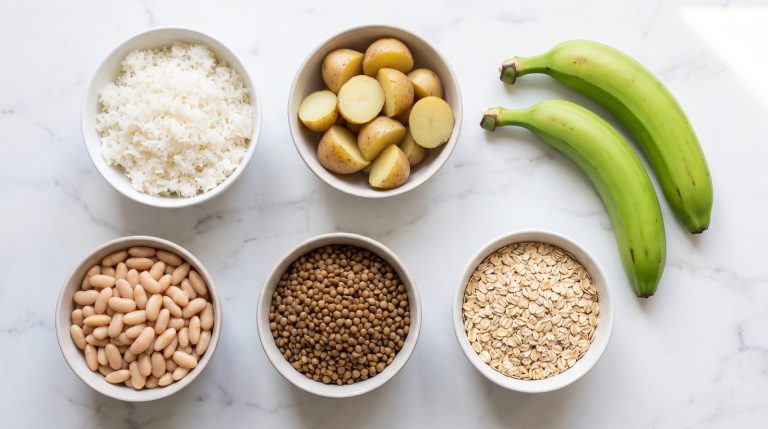
| Soluble | Oat bran and oats, barley, beans, lentils, peas, nuts, seeds, the flesh of fruit and vegetables, psyllium | Dissolves into a gel; slows digestion; binds cholesterol and bile acids | Cholesterol, steadier blood sugar, loose stools |
| Insoluble | Wheat bran, whole grains, vegetables, and the skins, strings and seeds of fruit and veg, nuts, corn | Does not dissolve; holds water in the stool and adds bulk | Constipation, regularity |
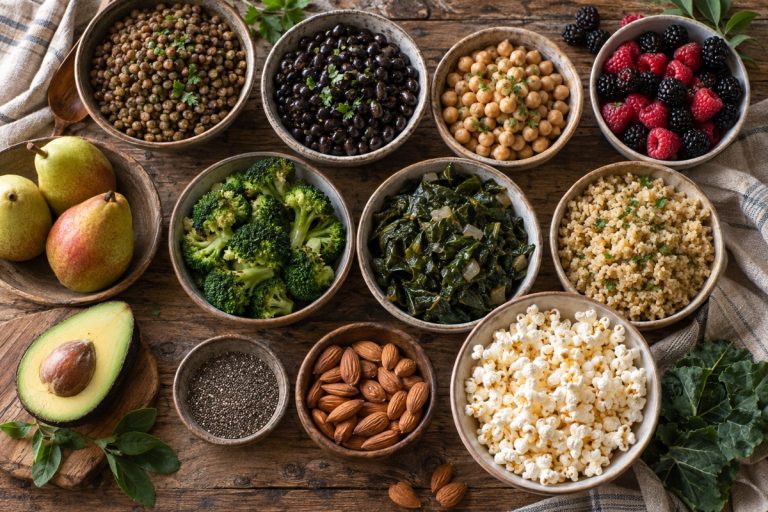
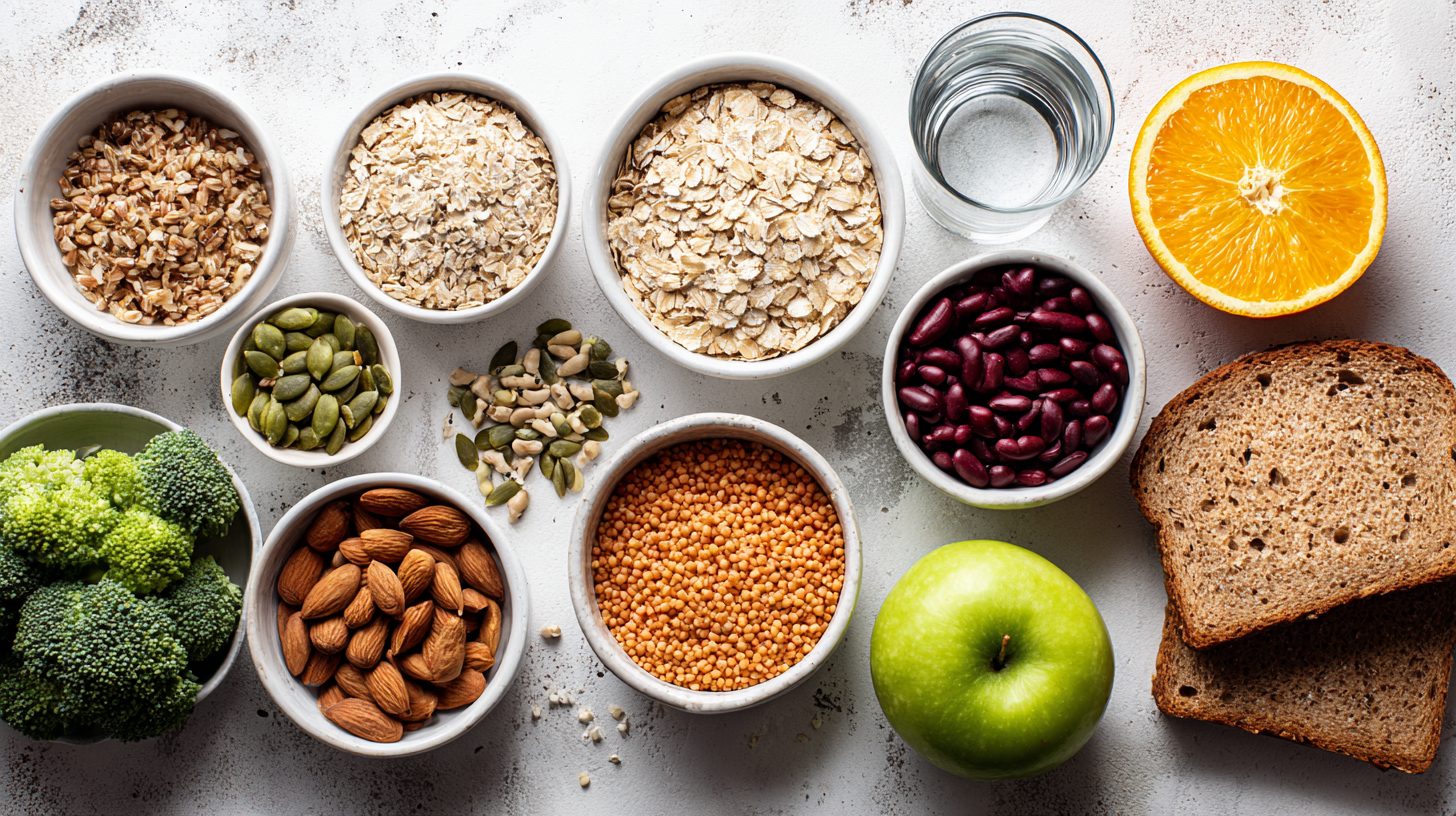
Notice how much appears on both rows. Nuts, seeds, beans and vegetables are all on the soluble list and all on the insoluble list, because they contain both — a bean is not a soluble food, it is a food with soluble fiber in it. The clean split exists in the chemistry, not in the aisle.
Why nobody can tell you your soluble grams
This is the honest bit, and it is missing from most versions of this article.
USDA’s standard reference table publishes total dietary fiber per food. It does not publish a soluble and insoluble breakdown for most foods, and the numbers that circulate online for individual foods’ splits come from scattered analyses of varying age and method. So when a chart tells you an apple is “2.4g total, of which 1.1g soluble”, treat that second number with more suspicion than the first.
There is also no separate intake target to aim at. The daily reference values — 38g for men and 25g for women under 50, 30g and 21g over 50 — are for total fiber, full stop. No health body sets a soluble target and an insoluble target, and US adults average around 17g of total fiber against those numbers, which tells you where the real problem is.
The single exception is regulatory, and it is specific. FDA’s authorised heart-disease health claim (21 CFR 101.81) is built on defined daily amounts of soluble fiber: 3g or more per day of beta-glucan soluble fiber from whole oats or barley, or 7g or more per day of soluble fiber from psyllium seed husk. Those are the only soluble-fiber numbers in this article that come with an official threshold attached, and they exist because that is what the cholesterol trials used.
In practice that is a bigger bowl than you think. The same regulation sets the floor for rolled oats at 4% beta-glucan by dry weight, so 3g means roughly 75g of dry oats — nearly double the 40g most people actually measure out. Worth knowing before you assume your usual porridge qualifies.
When the difference actually matters
Most of the time it does not, and eating a range of plants handles it. Three situations where it genuinely does:
| If you are dealing with… | Lean towards | In practice |
|---|---|---|
| Constipation | Insoluble, with more water | Wheat bran, wholegrain bread, vegetable skins, fruit eaten whole rather than juiced |
| Loose or urgent stools | Soluble | Oats, barley, psyllium — the gel adds form rather than speed |
| High LDL cholesterol | Soluble | Oats or barley daily; the FDA claim is built on 3g of beta-glucan a day |
| Blood sugar spikes after meals | Soluble | Beans, oats and barley alongside the carbohydrate, not instead of it |
| Simply eating too little fiber | Both — it does not matter | Add volume anywhere; you are nowhere near the point where the split is the limiting factor |
That last row is where most people actually are. If you are eating 17 grams a day, choosing between oats and bran is optimising the wrong variable — the fix is more plants of any kind, which is the argument we make at length in fibermixing.
One caution that applies to both types: fiber works with water, and increasing either kind sharply without drinking more can make constipation worse rather than better, which we go through in fiber for constipation. Increase gradually. If you have IBS, inflammatory bowel disease, a history of bowel obstruction, or you are on medication that fiber can interfere with, this is a conversation to have with your doctor rather than a chart to follow — the evidence on which fiber suits which gut condition is genuinely mixed, and it is individual.
What this changes in your kitchen
Four things, and they are all simple:
- Stop peeling things. The skin is where a large share of the insoluble fiber sits — an apple’s skin, a potato’s, the strings on celery. Peeling is the single most common way people quietly halve the fiber in a meal.
- Keep one gelling food in the daily rotation. Oats, barley, beans or a spoon of psyllium. This is the side most Western diets are short on, because it is the side that mostly is not in bread.
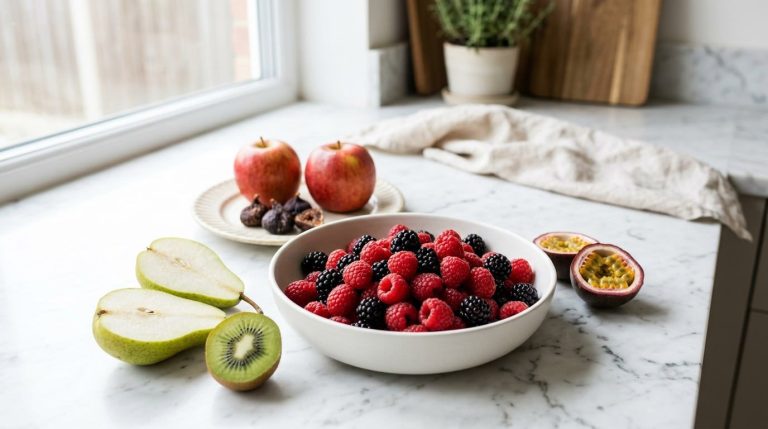
- Eat fruit, do not drink it. Juicing removes the fiber almost entirely; a whole orange has about 2.4g per 100g and its juice has close to none.
- Do not buy a supplement to fix a chart. Psyllium is genuinely useful for specific problems, but it is one fiber doing one job, and it will not replace a varied diet’s mixture.
A practical example: our high-fiber chili is a good illustration of getting both without thinking about it — the beans and lentils bring the soluble side, the peppers, corn and skins bring the insoluble, and the bowl adds up to 14 grams either way.
Common questions
Which one is better?
Neither, and any source that names a winner is overselling. They do different jobs and the recommendations are written for total fiber precisely because a normal diet delivers both. If you are choosing between them, you have already got past the stage where the choice matters much.
How do I know how much of each I am getting?
Realistically, you do not, and you do not need to. On the US Nutrition Facts label soluble and insoluble fiber “may be declared voluntarily” — a manufacturer only has to print them if it makes a claim about them, so most simply do not. USDA’s standard table publishes total fiber only, and per-food splits are patchy. Track total fiber, eat across the categories in the chart above, and let the split take care of itself.
Which one causes gas?
Mostly soluble, and its close relatives. Soluble fiber is fermentable — gut bacteria break it down and gas is a by-product — which is why beans and oats are the usual suspects and wheat bran is not. It generally settles over a few weeks as your gut adapts, provided you increase gradually rather than in one jump.
Is psyllium soluble or insoluble?
Mainly soluble, and it is the one supplement with a specific FDA-recognised threshold behind it: 7g a day of soluble fiber from psyllium seed husk for the heart-disease claim. It is unusual in that it gels strongly but is poorly fermented, which is why it tends to cause less gas than the same grams from beans.
Does cooking change the split?
Somewhat — heat and moisture can convert some insoluble fiber to soluble, and cooling cooked starches creates resistant starch, which behaves more like fermentable soluble fiber. The effect is real but small next to how much fiber you eat in the first place. Do not build a diet around it.
Do fiber supplements count towards the daily target?
They count, but they are one type of fiber where food gives you a mixture, plus everything else that comes with a plant. Use them to solve a specific problem — psyllium for stool form, for example — rather than as the main source. There is a fuller answer to this one in our fiber questions answered.
The bottom line
Soluble fiber gels and slows things down; insoluble fiber holds water and speeds things up. Both matter, most foods have both, there is no separate target for either, and the split is not something you can measure at home. Unless you are managing constipation, loose stools or cholesterol specifically, the useful question is not which kind you are eating but whether you are anywhere near 25 to 38 grams of it.
If the answer is no, start with fibermaxxing 101 for the ramp, then look at what 30 grams of fiber a day actually looks like to see how ordinary that day is. For the soluble side specifically, high-fiber pancakes and red lentil dal are the two we make most; for the insoluble side, keep the skins on everything in our high-fiber dinner ideas.
The distinction matters most in one specific claim you have probably met — that soluble fiber shrinks belly fat. What that study actually found is narrower than the headline, and worth reading before you change anything.
Get the free Fibermaxxing Starter Kit
A 7-day plan, 5 tested recipes & a fridge cheat sheet — straight to your inbox.
No spam, just recipes. Unsubscribe anytime.

Emma Hartwell
Emma Hartwell is the home cook and recipe developer behind Fiber & Fork. After years of dealing with sluggish digestion and endless afternoon energy crashes, she rebuilt her kitchen around one simple idea: hit 30 grams of fiber a day without eating a single boring meal. Every recipe on this site is cooked, photographed, and taste-tested in her own kitchen — beans, lentils, whole grains, and vegetables turned into food you'll actually crave. When she's not stirring a pot of something cozy, Emma is testing new ways to sneak fiber into desserts her family can't tell apart from the 'real thing'.