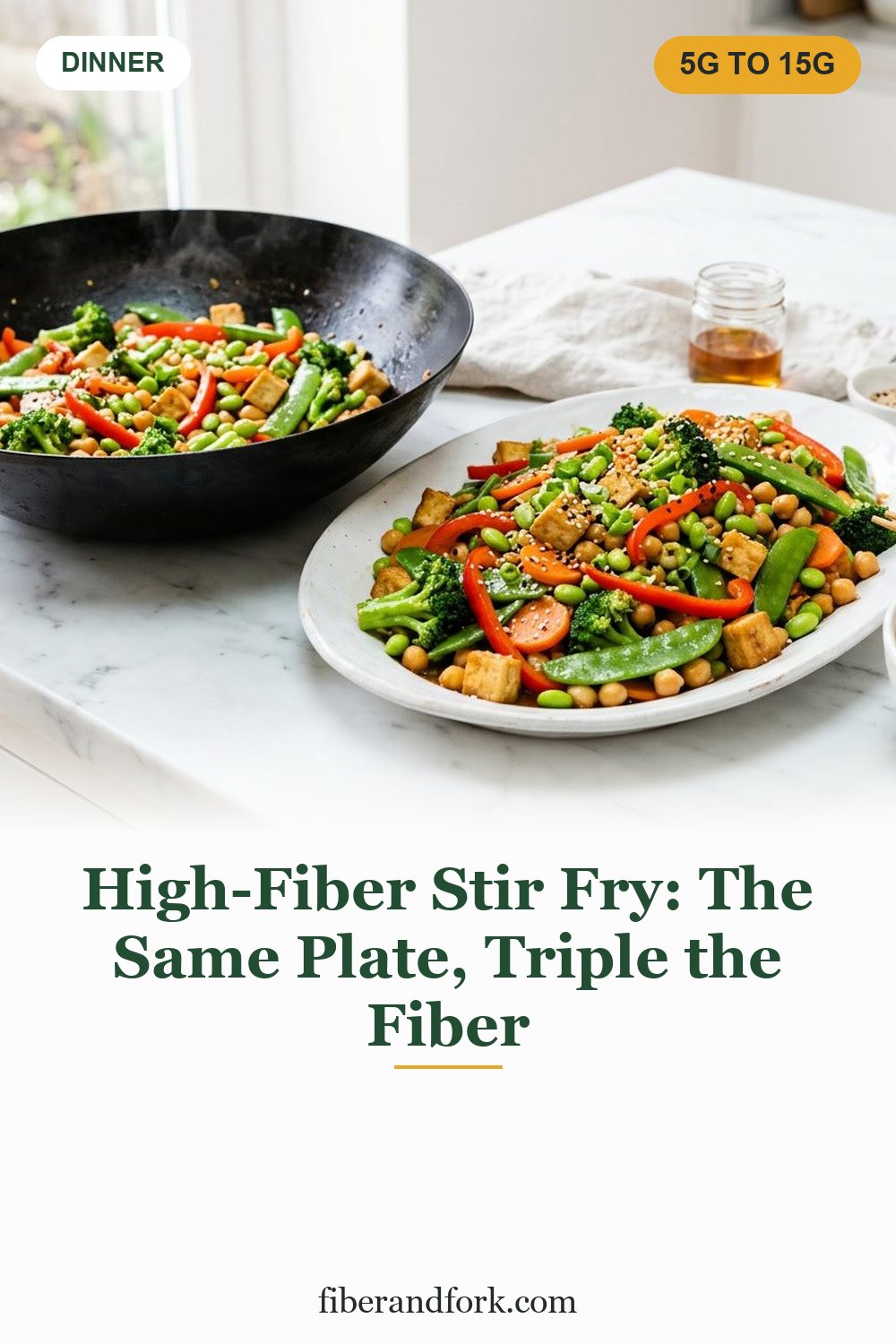
High-Fiber Stir Fry: How to Take One Plate From 5g to 15g
A chicken and broccoli stir fry looks like a plate of vegetables. Over white rice, it comes to about 5 grams of fiber. The broccoli, pepper and bok choy do their part. The cup of white rice has 0.6 grams and the chicken has none, and those two make up most of the plate.
More vegetables won’t fix that much. Two swaps will: the grain under the stir fry, and half a cup of a legume in the wok. Together they take the same plate, with the same chicken, from 5.0 grams to 15.2 grams. Every number here comes from USDA’s SR Legacy tables.
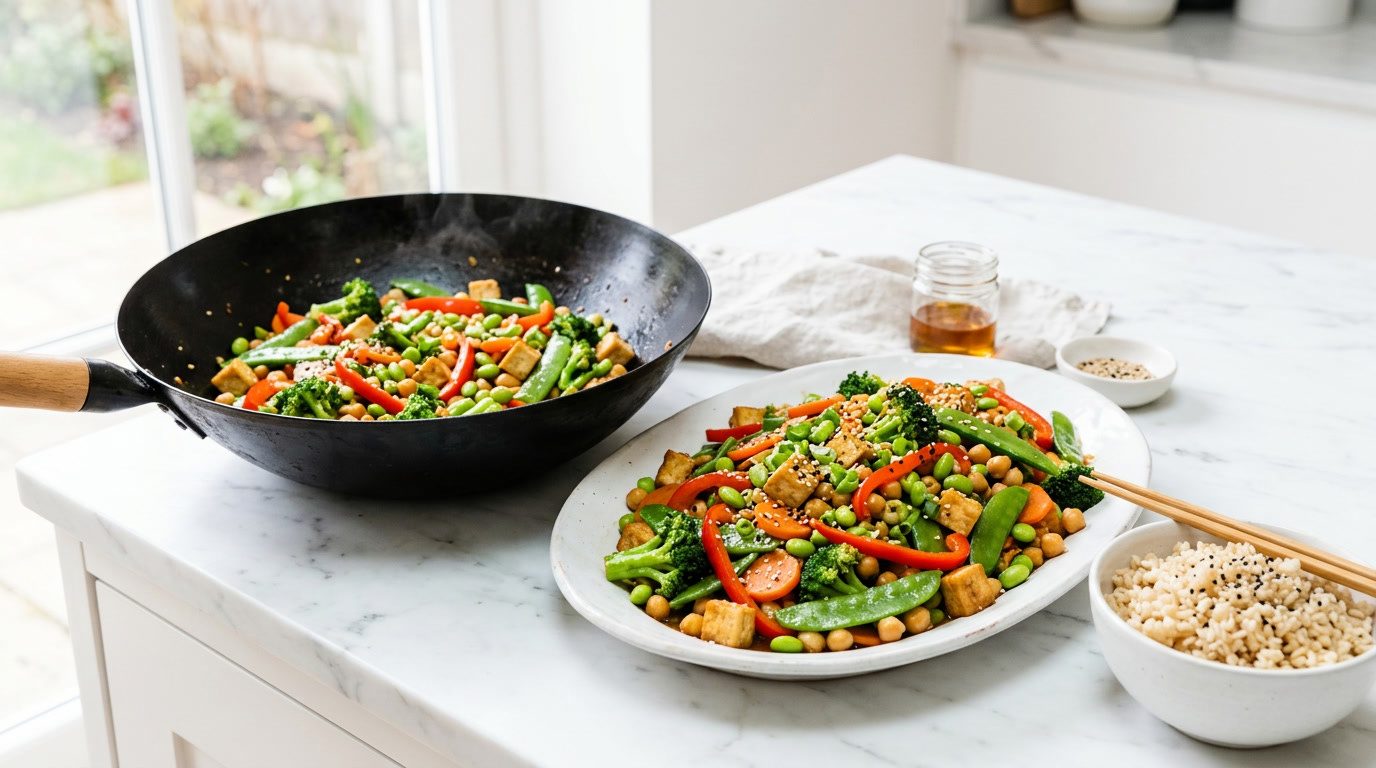
The short version
- A takeout-style chicken stir fry over white rice: 5.0g of fiber
- The same chicken over quinoa, with edamame and snow peas: 15.2g
- White rice has 0.6g of fiber a cup. Bulgur has 8.2g, for fewer calories (151 vs 205)
- Brown rice, the usual swap, has 3.2g. Quinoa (5.2g) and pearl barley (6.0g) beat it
- Edamame (8.1g a cup) and chickpeas (9.6g) add more fiber than any vegetable in the wok
- Among vegetables, Brussels sprouts and broccoli lead per cooked cup. Bok choy and red pepper are near the bottom
Where the fiber in a stir fry comes from
Here is the same dinner built two ways. Both use three-quarters of a cup of cooked chicken breast. The amounts are per plate, and oil and sauce are left out of both, because they add calories and no fiber.
| Takeout-style plate | Fiber | Upgraded plate | Fiber |
|---|---|---|---|
| White rice, 1 cup | 0.6g | Quinoa, 1 cup | 5.2g |
| Chicken breast, ¾ cup | 0.0g | Chicken breast, ¾ cup | 0.0g |
| — | — | Edamame, ½ cup | 4.0g |
| Broccoli, ½ cup | 2.6g | Broccoli (frozen), ½ cup | 2.8g |
| Bok choy, ½ cup | 0.8g | Snow peas, ½ cup | 2.2g |
| Red pepper, ½ cup sliced | 1.0g | Red pepper, ½ cup sliced | 1.0g |
| Total | 5.0g | Total | 15.2g |
The grain and the edamame account for 8.6 of the 10.2 extra grams. Snow peas in place of bok choy add 1.4 more, and frozen broccoli the last 0.2. The upgraded plate also has more protein, 56 grams against 41, and 560 calories against 428. Most of those extra calories, 94 of 132, come from the edamame.
1. Change the grain
The grain is usually the largest thing on the plate, so it matters most. Here are the usual stir-fry bases, per cooked cup:
| # | Base (cooked) | Cup weight | Fiber | Calories |
|---|---|---|---|---|
| 1 | Bulgur | 182g | 8.2g | 151 |
| 2 | Pearl barley | 157g | 6.0g | 193 |
| 3 | Quinoa | 185g | 5.2g | 222 |
| 4 | Brown rice, long-grain | 202g | 3.2g | 248 |
| 5 | Egg noodles | 160g | 1.9g | 221 |
| 6 | Rice noodles | 176g | 1.8g | 190 |
| 7 | White rice, long-grain | 158g | 0.6g | 205 |
Brown rice is the swap most people make, and it’s a modest one: 3.2 grams, with the most calories on the list. Quinoa and barley both beat it. Bulgur is the standout, with 8.2 grams of fiber and fewer calories than white rice. It isn’t a traditional stir-fry base, but it cooks like rice and has a mild, nutty taste.
Soba noodles aren’t in the table because USDA’s SR Legacy entry for cooked soba has no fiber value. We don’t fill in a guess. The grain ranking covers 17 cooked grains.
2. Add a legume, even if you keep the meat
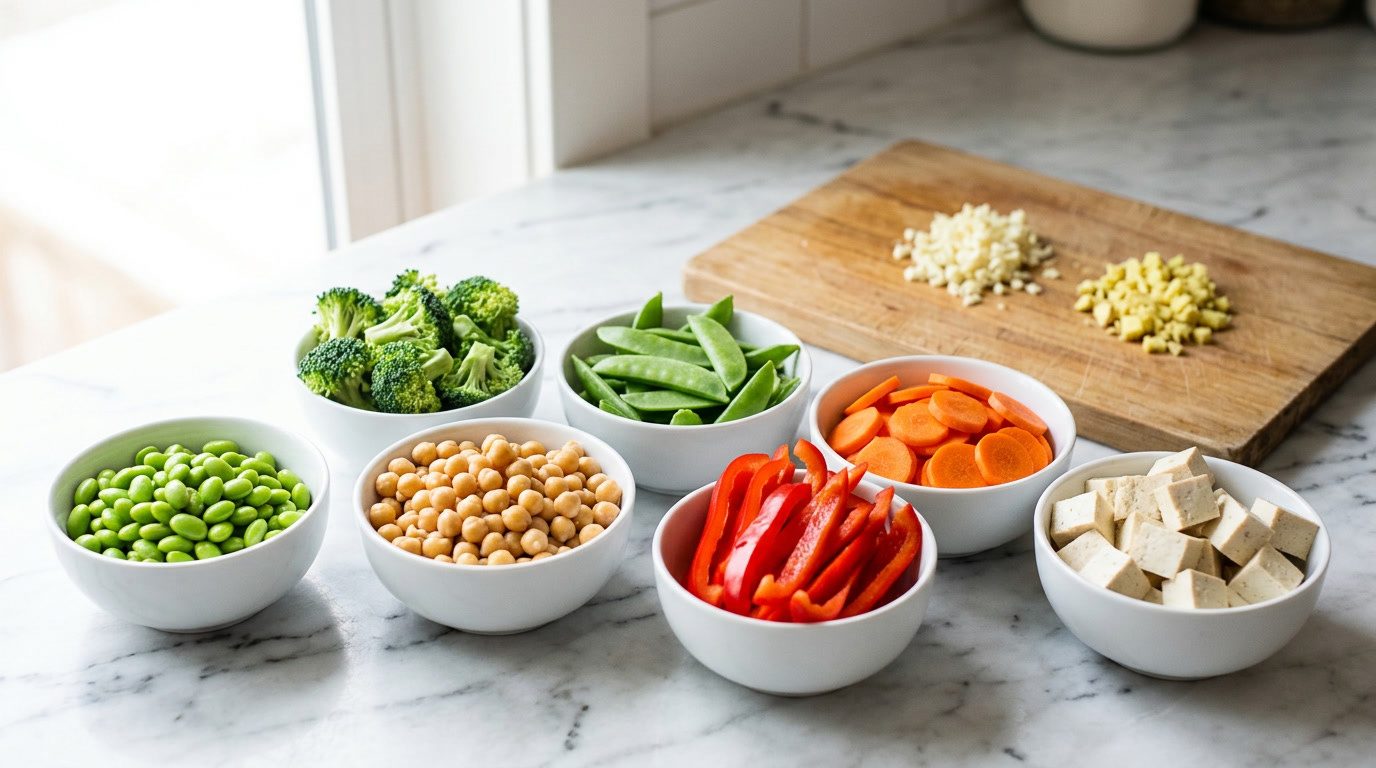
Fiber comes from plants, so chicken, beef, pork and shrimp have none. USDA lists cooked chicken breast at 0.0 grams. That doesn’t mean you have to drop them. Add a legume alongside them:
| Protein | Serving | Fiber | Protein | Calories |
|---|---|---|---|---|
| Chickpeas, canned, rinsed | 1 cup (152g) | 9.6g | 10.7g | 210 |
| Edamame, frozen, cooked | 1 cup (155g) | 8.1g | 18.5g | 188 |
| Firm tofu | ½ cup (126g) | 2.9g | 21.8g | 181 |
| Chicken breast, cooked | 1 cup diced (140g) | 0.0g | 43.4g | 231 |
Edamame is the easiest to add. It comes frozen and shelled, you can toss it straight into the wok, and a cup brings 18.5 grams of protein along with the fiber. Chickpeas have the most fiber, and they brown well in a hot pan if you pat them dry first. Tofu has more protein per calorie than either, but less fiber. Tempeh isn’t listed because USDA SR Legacy has no fiber value for it.
3. Choose vegetables by the cooked cup
Vegetables shrink in the wok, so compare them by the cooked cup. That’s what ends up on the plate:
| # | Vegetable (cooked) | Cup weight | Fiber per cup |
|---|---|---|---|
| 1 | Brussels sprouts (frozen) | 155g | 6.4g |
| 2 | Broccoli (frozen, chopped) | 184g | 5.5g |
| 3 | Broccoli (fresh, chopped) | 156g | 5.1g |
| 4 | Carrots (frozen, sliced) | 146g | 4.8g |
| 5 | Kale | 118g | 4.7g |
| 6 | Snow peas | 160g | 4.5g |
| 7 | Green beans | 125g | 4.0g |
| 8 | White mushrooms | 156g | 3.4g |
| 9 | Onion | 210g | 2.9g |
| 10 | Red bell pepper (sautéed) | 106g | 1.9g |
| 11 | Bok choy | 170g | 1.7g |
Red pepper and bok choy show up in almost every stir fry and sit at the bottom of this table. That’s no reason to drop them, since they bring color and crunch. Just don’t count on them for fiber. Frozen broccoli has as much as fresh, so the bag in the freezer works fine. For the full vegetable ranking, see high-fiber vegetables.
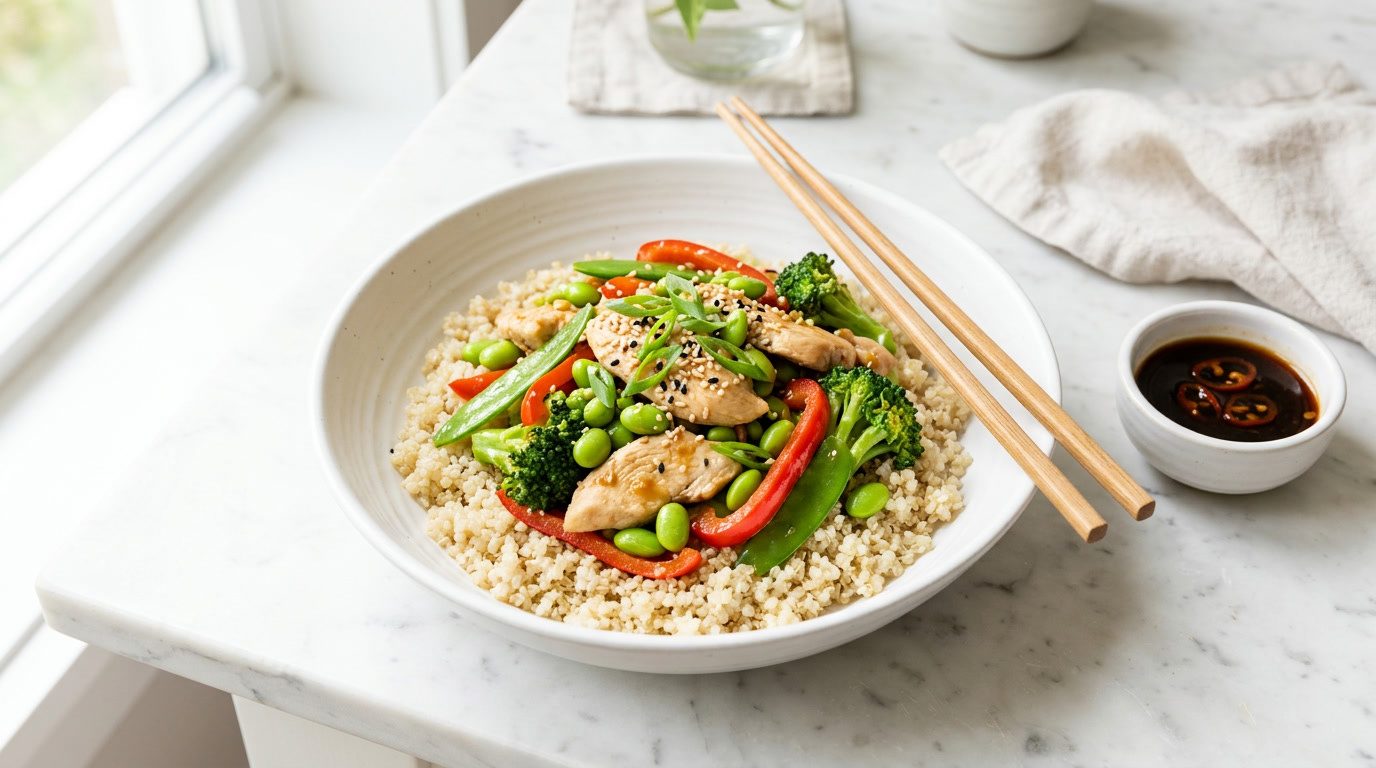
Four high-fiber stir fry plates
Each plate combines one grain, one legume or protein, and vegetables from the top half of the table. The amounts are per plate, without oil or sauce.
| Plate | What’s in it | Fiber | Protein | Calories |
|---|---|---|---|---|
| Chickpea and green bean over bulgur | 1 cup bulgur, ½ cup chickpeas, 1 cup green beans, ½ cup carrots | 19.4g | 14g | 327 |
| Edamame and Brussels sprouts over barley | 1 cup barley, ½ cup edamame, 1 cup Brussels sprouts, ½ cup red pepper | 17.3g | 19g | 364 |
| Chicken, edamame and snow peas over quinoa | 1 cup quinoa, ¾ cup chicken, ½ cup edamame, ½ cup broccoli, ½ cup snow peas, ½ cup red pepper | 15.2g | 56g | 560 |
| Tofu, broccoli and mushroom over brown rice | 1 cup brown rice, ½ cup tofu, 1 cup broccoli, ½ cup mushrooms | 13.4g | 35g | 503 |
The chickpea and bulgur plate has the most fiber and the fewest calories. The chicken plate has the most protein. Even the tofu and brown rice plate, the mildest upgrade, has more than two and a half times the fiber of the takeout version.
A practical order: start the grain first, since it takes the longest. Stir-fry the protein, then the firm vegetables, then the quick ones like snow peas and frozen edamame. Add the sauce last. If you’re cooking for the week, the grain and the legumes keep well, and high-fiber lunch meal prep shows how to portion them.
Frequently asked questions
Is stir fry high in fiber?
Usually not over white rice. A typical chicken and vegetable plate comes to about 5 grams, because the rice and meat carry almost none. With a whole grain and a legume, the same dish reaches 13 to 19 grams a plate.
Is brown rice high in fiber?
It has more than white rice, 3.2 grams a cup against 0.6. Among grains, though, it’s middling. Quinoa has 5.2 grams, pearl barley 6.0 and bulgur 8.2, and bulgur has fewer calories per cup.
Does stir-frying destroy fiber?
USDA’s figures don’t show a loss from cooking. Spinach, for example, has 2.2 grams of fiber per 100 grams raw and 2.4 grams cooked. What changes is volume: a cup of cooked vegetables holds far more food than a cup of raw ones. That’s why this page compares vegetables by the cooked cup.
Are frozen stir-fry vegetables as good as fresh?
For fiber, yes. Frozen chopped broccoli has 5.5 grams per cooked cup and fresh has 5.1. Frozen edamame and snow peas are among the easiest high-fiber things to keep on hand for a quick stir fry.
What is the highest-fiber stir fry protein?
Among the options here, chickpeas, with 9.6 grams a cup. Edamame is close behind at 8.1 grams, with more protein. Meat, poultry and seafood have none, so pair them with one of the two.
More dinners built the same way: high-fiber dinner ideas, sheet-pan dinners, high-fiber chicken recipes and high-protein, high-fiber meals. To choose your legume, see the bean ranking, and to start the day the same way, try high-fiber oatmeal.
Get the free Fibermaxxing Starter Kit
A 7-day plan, 5 tested recipes & a fridge cheat sheet — straight to your inbox.
No spam, just recipes. Unsubscribe anytime.

Emma Hartwell
Emma Hartwell is the home cook and recipe developer behind Fiber & Fork. After years of dealing with sluggish digestion and endless afternoon energy crashes, she rebuilt her kitchen around one simple idea: hit 30 grams of fiber a day without eating a single boring meal. Every recipe on this site is cooked, photographed, and taste-tested in her own kitchen — beans, lentils, whole grains, and vegetables turned into food you'll actually crave. When she's not stirring a pot of something cozy, Emma is testing new ways to sneak fiber into desserts her family can't tell apart from the 'real thing'.