Resistant Starch Foods: The Fiber You Make in Your Own Kitchen
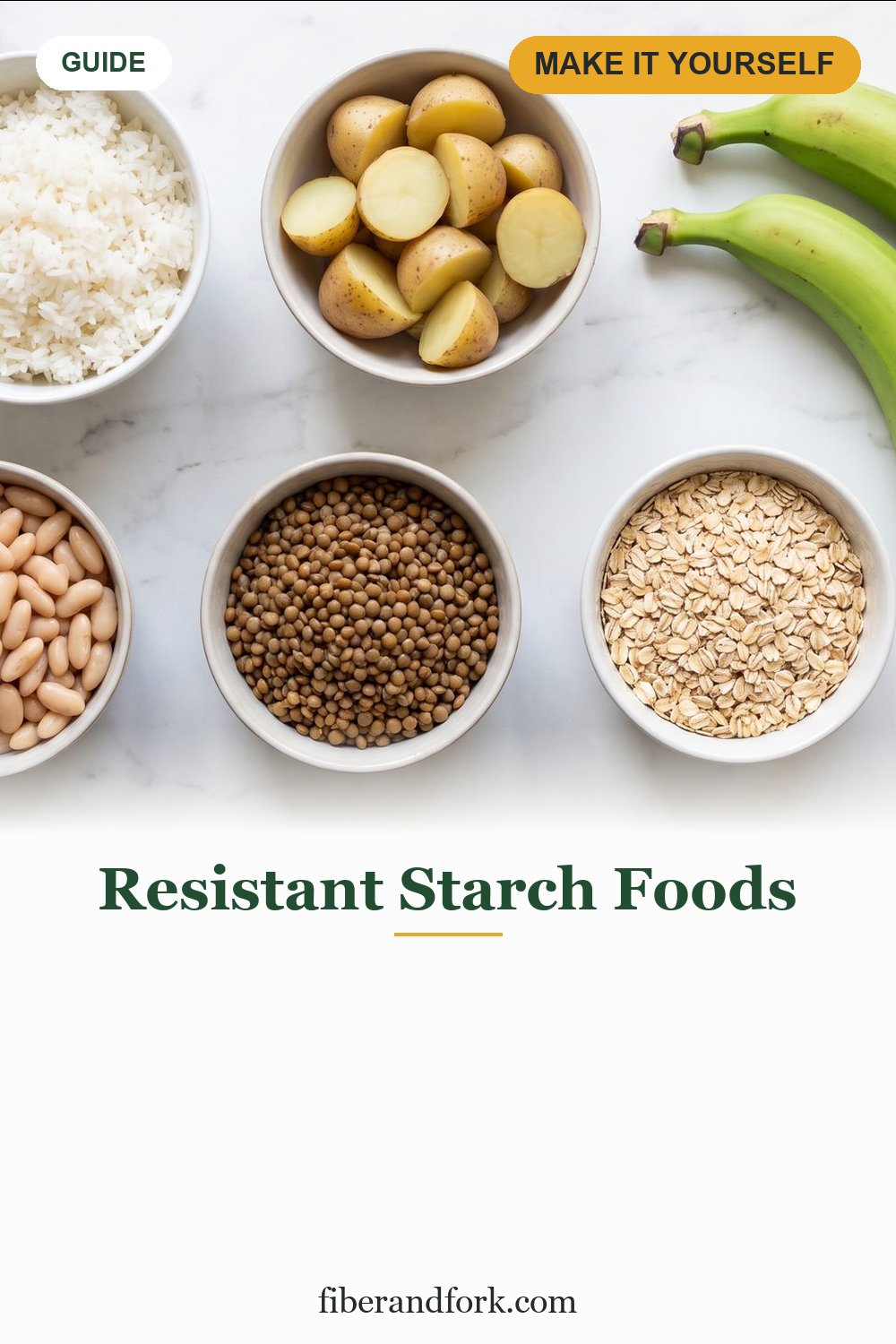
Resistant starch is the only fiber you can create in your own kitchen. Cook rice, potatoes or pasta, let them go completely cold, and some of the starch rearranges into a form your small intestine can no longer digest. It travels on to your colon and behaves like fiber — and reheating does not undo it.
It is also the fiber with the least trustworthy numbers on the internet. Nutrition labels do not list it, USDA’s standard tables do not carry it, and published measurements disagree with each other by several hundred percent. This page gives you ranges and the reason they are ranges, rather than a confident table that would be quietly made up.
The short version
- Cook then cool is the whole technique — reheating keeps the benefit
- Legumes and green-tipped bananas are the highest natural sources
- It ferments readily, which is why it feeds gut bacteria — and causes gas
- Published amounts vary hugely; treat any precise-looking figure with suspicion
What makes it “resistant”
Ordinary starch is a chain of glucose your enzymes snip apart in the small intestine, and the glucose enters your blood. Resistant starch has a structure those enzymes cannot get into — either because of how the plant built it, or because of what cooling did to it after cooking.
So it reaches the colon intact, where bacteria ferment it. That fermentation produces short-chain fatty acids, which is the same route by which fermentable fiber influences appetite hormones — covered in foods that boost GLP-1 naturally. Functionally it is fiber, even though it is chemically a starch.
The sources, and why the numbers are ranges
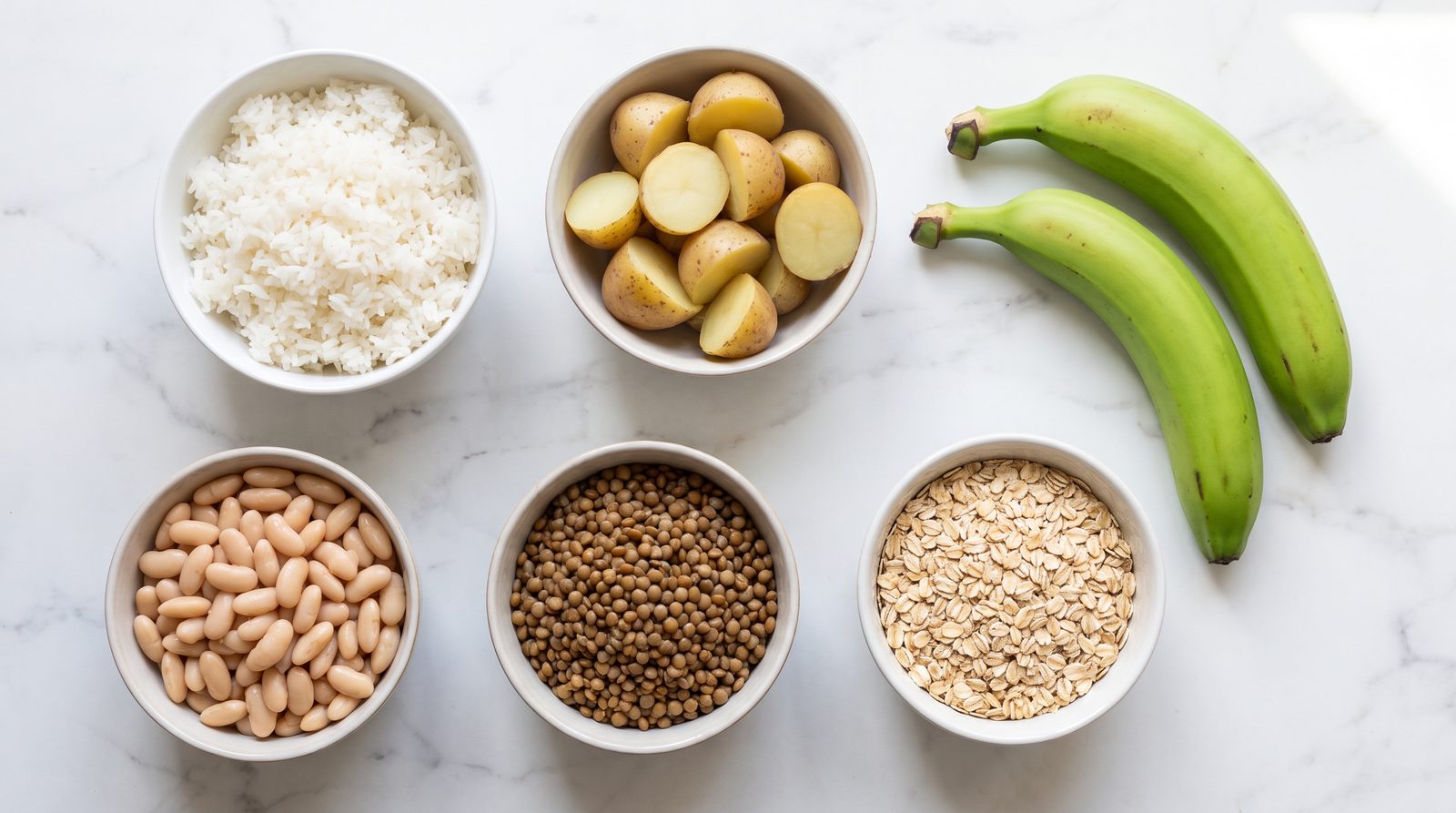
Every figure below is a range because the published measurements genuinely disagree. A cooked-and-cooled potato has been reported anywhere from about 2 to 5 grams per 100g depending on the variety, how long it was cooled, and which laboratory assay was used.
| Food | Portion | Resistant starch | Notes |
|---|---|---|---|
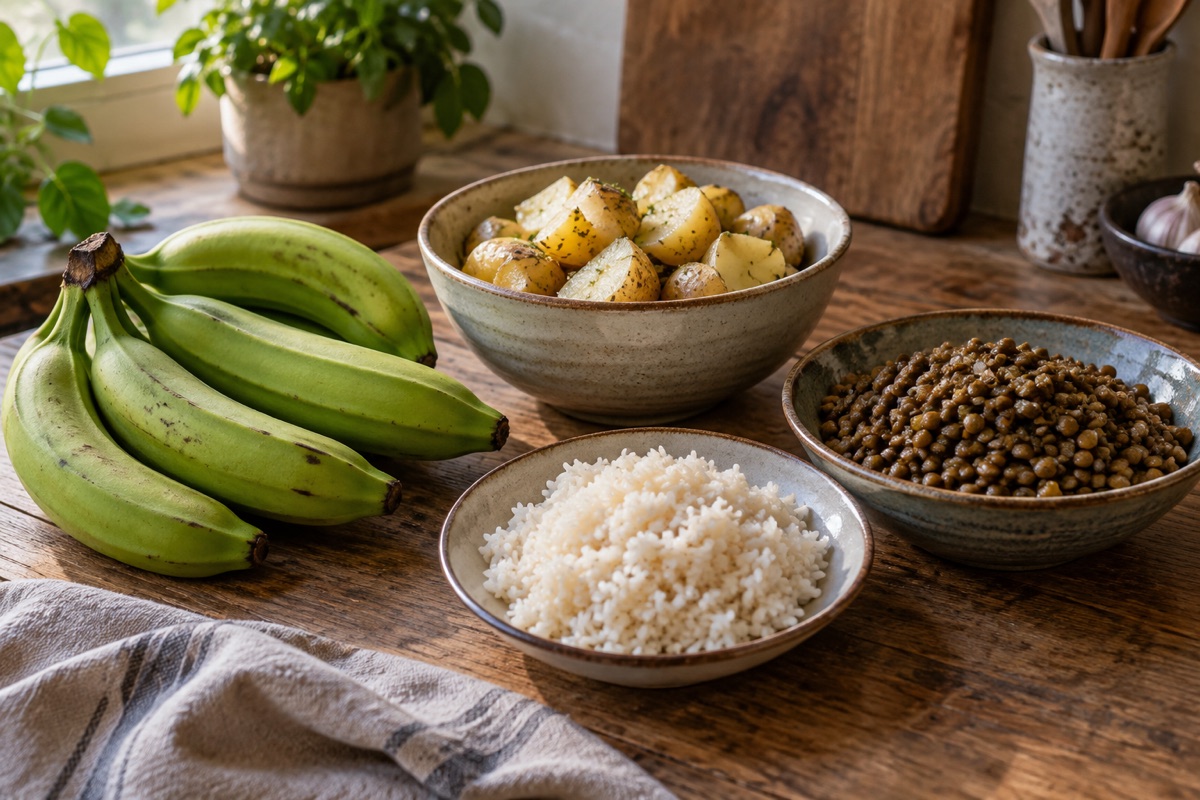
| Green-tipped banana | 1 medium | ~4–6g | Falls sharply as it ripens |
| Cooked & cooled potato | 1 medium | ~4–8g | Cool fully, not just warm |
| Cooked & cooled rice | 1 cup | ~3–4g | Roughly doubles vs freshly cooked |
| White beans, cooked | 1 cup | ~3–4g | On top of 11g total fiber |
| Lentils, cooked | 1 cup | ~2–3g | On top of 15.6g total fiber |
| Cooked & cooled pasta | 1 cup | ~2–3g | Pasta salad, essentially |
| Rolled oats, raw | ½ cup | ~1–3g | Cooking lowers it — overnight oats keep more |
Two directions worth separating, because they run opposite ways. Starchy cooked foods gain resistant starch when cooled. Raw sources — oats, green banana, raw potato starch — lose it when cooked. That is why overnight oats hold more than a hot bowl of porridge made from the same oats.
How to actually get it
- Cook rice or potatoes the day before. Fridge overnight, then reheat or eat cold. Yesterday’s rice is the single easiest source in this list.
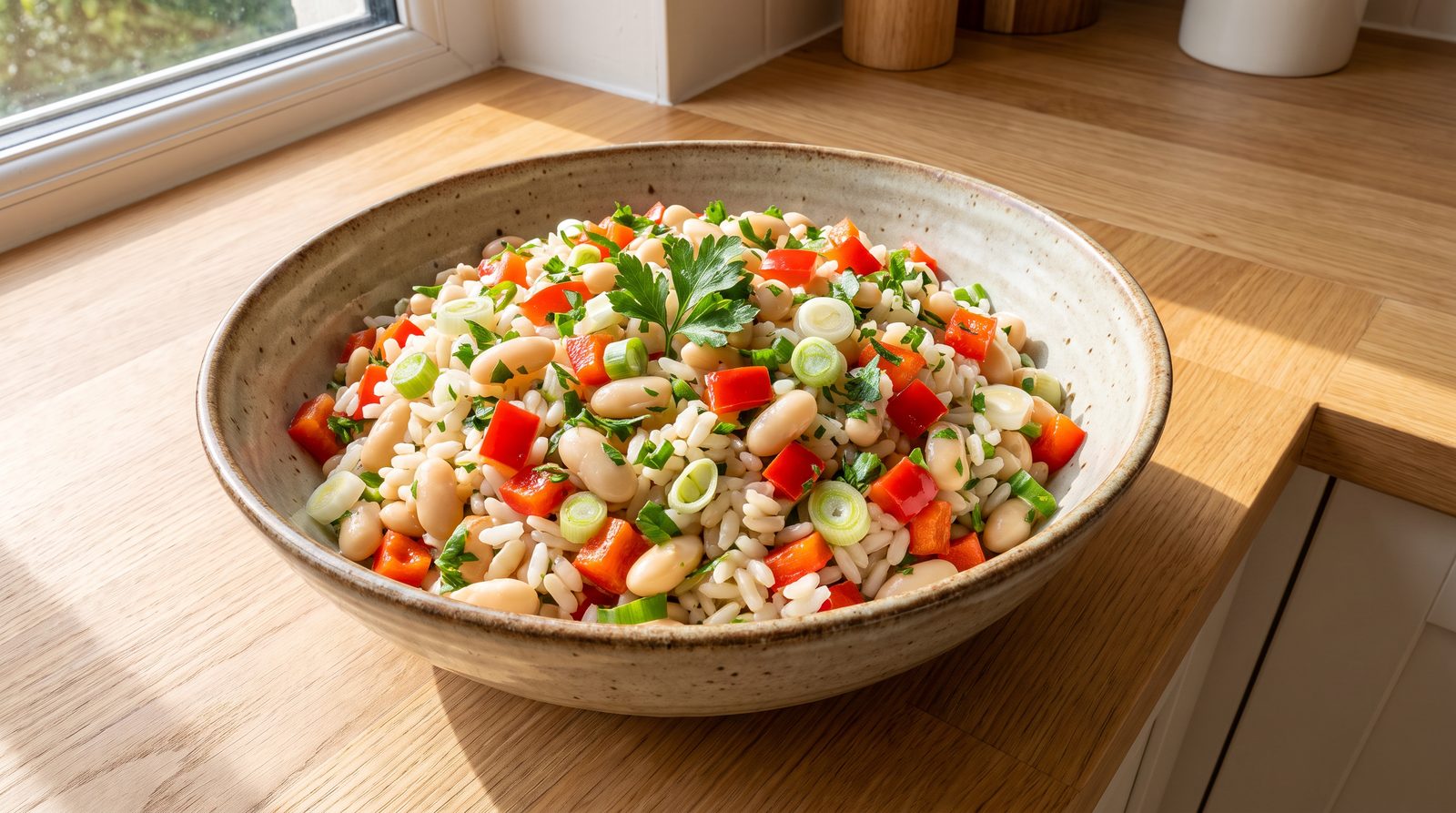
- Make it a salad. Potato salad and pasta salad are resistant starch by design, not by health-food intent. Our high-fiber pasta salad is built cold for exactly this reason.
- Buy bananas slightly under-ripe and eat them while the tips are still green. Once they are spotted, most of it has turned to sugar.
- Choose overnight oats over porridge when you want the resistant starch — recipe here.
- Eat legumes. They carry resistant starch and 12–16g of ordinary fiber per cup, which is why they top nearly every list on this site.
Frequently asked questions
Does reheating destroy it?
No — this is the part that makes the technique practical. Once the starch has recrystallised during cooling, reheating does not reverse it to any meaningful degree. Cold rice reheated is still a better source than rice eaten straight from the pot.
How long does it need to cool?
Fully cold, and longer is better — a few hours at minimum, overnight in the fridge for the most reported effect. Ten minutes on the counter is not enough. Studies that measured a 24-hour cool consistently found more than those measuring a short one.
Why can I not find a proper number for this?
Because it is genuinely hard to measure and there is no single agreed method. Resistant starch is not required on nutrition labels and is not in USDA’s standard nutrient tables, so every figure you see online traces back to individual studies using different varieties, different cooking, different cooling times and different laboratory assays. When a site gives you a confident number to one decimal place, that precision is invented.
Does it spike blood sugar like normal starch?
Less, since the portion that resists digestion is not absorbed as glucose — which is the basis of the interest in it. The food is not carb-free, though; the rest of the starch behaves normally. If you are managing diabetes, treat this as background and work from your care team’s advice.
Will it make me gassy?
Very likely at first, and that is the mechanism working — fermentation is how it does anything at all, and gas is the by-product. It settles as your gut adapts, and it scales with how fast you increased. See too much fiber symptoms for where normal ends.
Resistant starch is one of several fermentable fibers — soluble vs insoluble fiber explains where it sits, and fiber questions, answered covers the rest. For meals that carry it without thinking about it, start with high-fiber lunch meal prep, which is cold by design.
Resistant starch is one of several fibers your gut bacteria ferment; the others are covered in prebiotic foods: what actually feeds your gut bacteria.
Get the free Fibermaxxing Starter Kit
A 7-day plan, 5 tested recipes & a fridge cheat sheet — straight to your inbox.
No spam, just recipes. Unsubscribe anytime.

Emma Hartwell
Emma Hartwell is the home cook and recipe developer behind Fiber & Fork. After years of dealing with sluggish digestion and endless afternoon energy crashes, she rebuilt her kitchen around one simple idea: hit 30 grams of fiber a day without eating a single boring meal. Every recipe on this site is cooked, photographed, and taste-tested in her own kitchen — beans, lentils, whole grains, and vegetables turned into food you'll actually crave. When she's not stirring a pot of something cozy, Emma is testing new ways to sneak fiber into desserts her family can't tell apart from the 'real thing'.