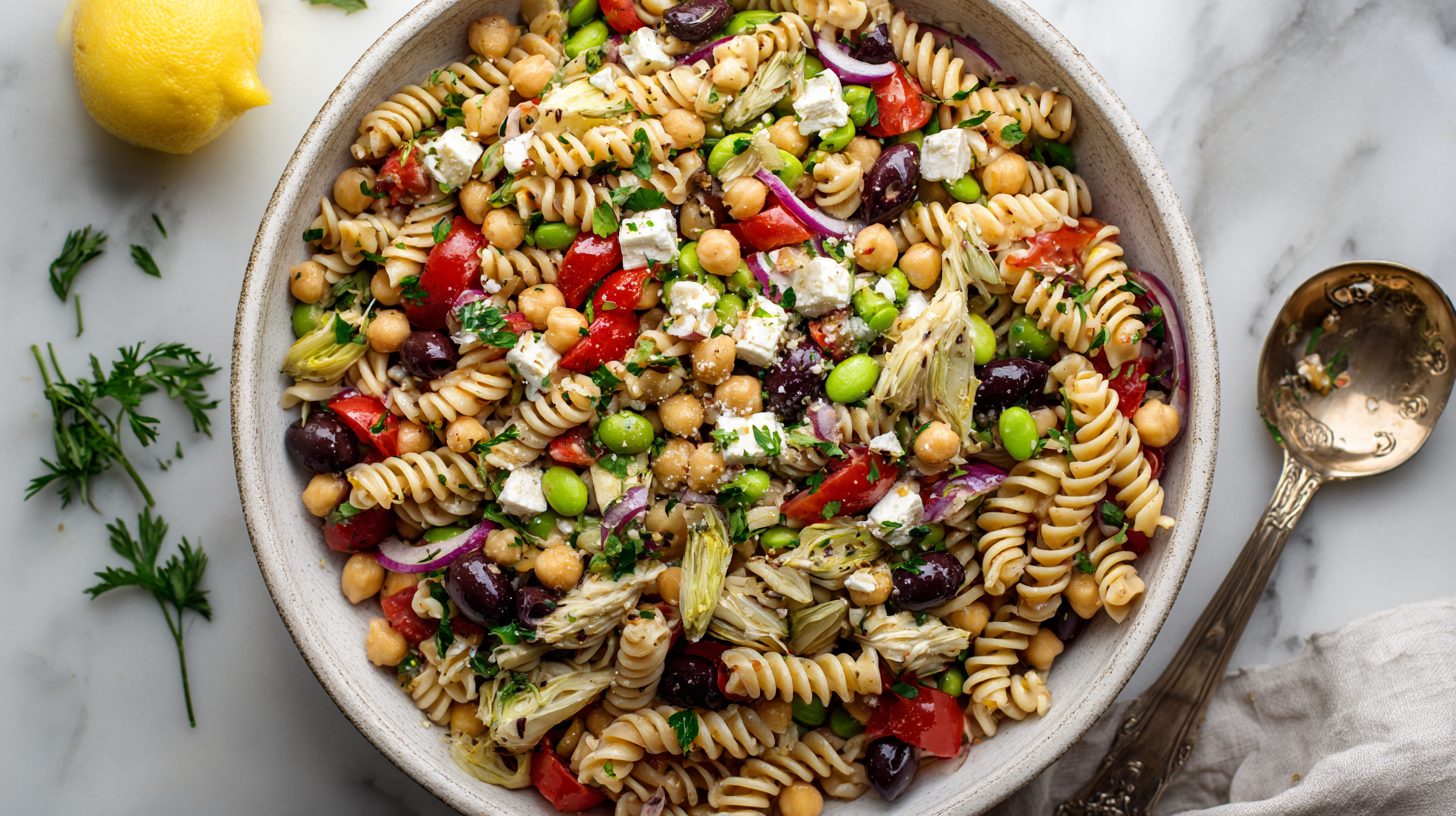
Ingredients
Method
- Do all the cutting first. Dice the pepper and cucumber, halve the tomatoes, slice the onion and olives, quarter the artichokes, drain and rinse the chickpeas, chop the spinach and tear the parsley. Shake the oil, lemon juice, oregano, garlic and mustard together in a jar. Put a large tray on the counter. The dressing step later gives you about a two-minute window and you do not want to be chopping inside it.
- Boil the pasta in well-salted water for one minute LONGER than the packet says. This is deliberate: pasta firms up as it chills, and whole-wheat pasta cooked to a proper al dente turns tight and slightly chalky in the fridge. Add the frozen edamame to the same pan for the last 3 minutes.
- Drain, and do not rinse. Rinsing is what ruins pasta salad — it washes off the surface starch and cools the strands so the dressing has nothing to soak into, and it slides off into a puddle at the bottom of the bowl instead.
- Tip the hot pasta and edamame straight into a large bowl and pour over two-thirds of the dressing while it is still steaming. Toss hard for 30 seconds. It will look like too much dressing; watch it disappear into the pasta as you stir. This is the whole anti-dryness trick — the pasta has its drink now, so it stops pulling moisture out of the tomatoes and cucumber later.
- Spread the dressed pasta out on the tray for about 5 minutes, until it is no longer hot to the touch. Cooling it flat stops the residual heat softening it further, without water touching it.
- Return the pasta to the bowl and fold through the chickpeas, artichokes, pepper, tomatoes, cucumber, onion, olives and spinach.
- Add the feta and parsley last, folding two or three times only. Any more and the feta smears through everything and turns it grey.
- Taste it cold, not warm — chilled food needs noticeably more salt and acid than the same food hot, and this is the step most pasta salads skip. Keep the last third of the dressing in the jar in the fridge, and stir it through just before serving, or tomorrow.
Notes
Fiber: 67.3g across the whole bowl, so 11.2g per serving of six, computed from USDA values for the exact weights above — 23.0g whole-wheat pasta, 16.0g chickpeas, 10.4g edamame, 6.9g artichokes, 3.2g red pepper, 2.4g tomatoes, 1.3g spinach, 1.3g herbs, 1.0g onion, 1.0g olives, 0.7g cucumber. The same salad built the usual way, on white pasta with no chickpeas or edamame, comes to about 4.3g a serving.
Only fiber is listed in the nutrition block. That is the figure we can calculate from USDA data for these exact weights. Calories and macros would be estimates, and we would rather leave them out than print a guess.
Hold back a third of the dressing. Stirred through the next day it wakes the whole thing up. This is the difference between leftovers and a salad that is genuinely better on day two.
Keeps 3 days refrigerated. Cucumber softens by day three — leave it out if you are making it for the end of the week. Do not freeze it: the cucumber, tomatoes and feta all collapse.
Legume pasta: chickpea or lentil pasta raises the fiber again, but take it off at the packet time rather than a minute over, and dress it warm rather than steaming — it goes soft fast.
Dairy-free: leave out the feta and add 60g of toasted almonds for the salt-and-crunch job. That adds roughly 7g of fiber to the bowl.